A School Cannot Fulfil Its Mission If Its Model Is Unsustainable
Education leaders are often uncomfortable discussing business. That discomfort is understandable: a school is not a factory, and children are not products. Yet refusing to discuss finance does not protect educational values. It can quietly endanger them.
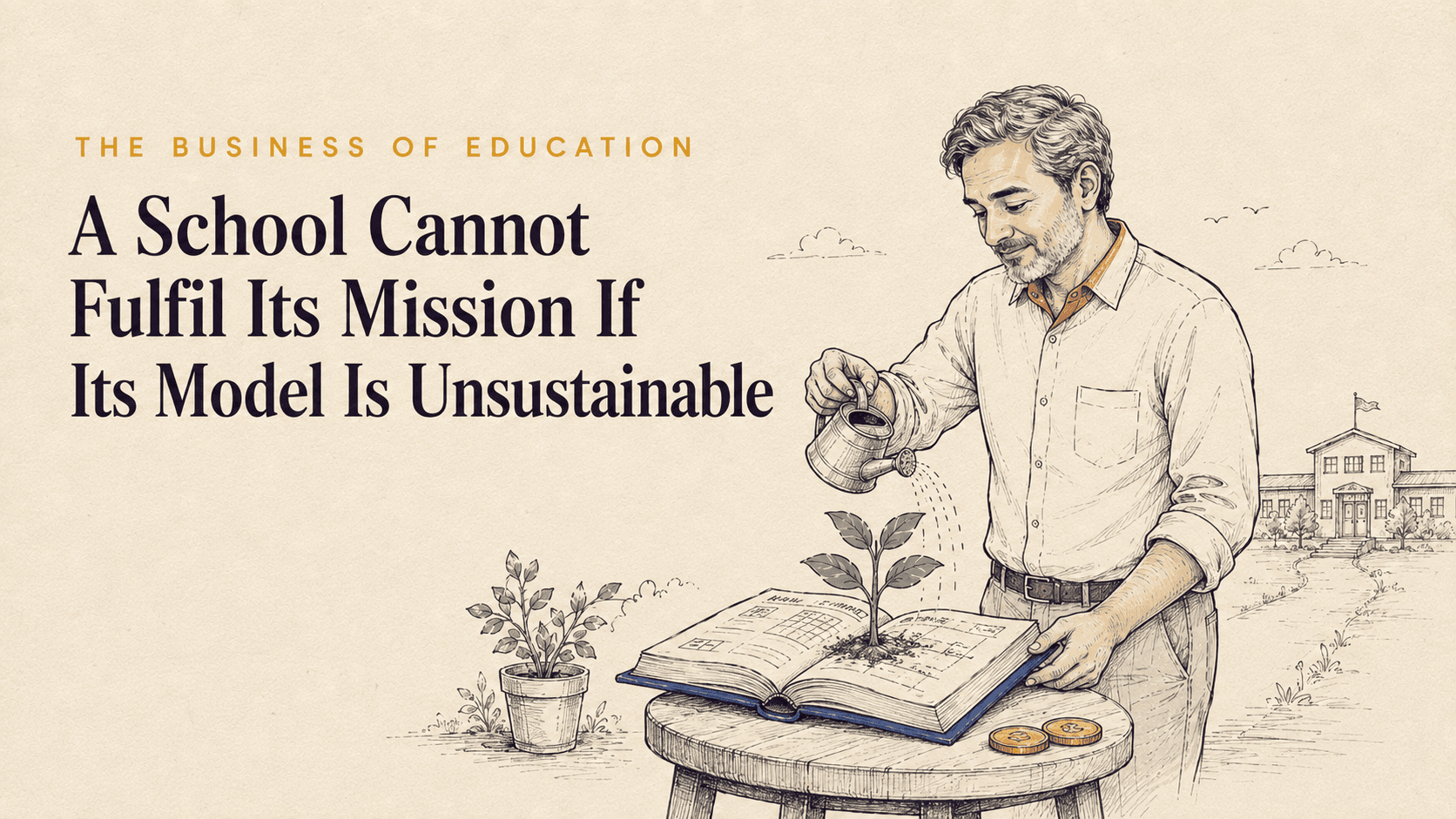
A sustainable school model ensures that fees, staffing and growth decisions support learning over time. Teacher salaries, professional development, safeguarding, maintenance, technology and student support require predictable resources. If fees are disconnected from the value delivered, parents lose trust. If fees are kept artificially low without operational discipline, quality eventually pays the hidden price.
Schools rarely fail because of one dramatic decision. More often, they weaken through small mismatches: expanding before the first campus has a stable culture, hiring rapidly without induction, adding facilities that create prestige but little learning value, or using enrolment growth to hide inefficient systems.
Expansion is particularly seductive. A second branch can look like proof of success, but scale multiplies whatever already exists. If teacher development, curriculum quality and parent communication are strong, growth can extend impact. If they are inconsistent, growth distributes inconsistency across more children. The correct question is not, “Can we open another school?” but, “Can we reproduce the learning experience without diluting it?”
The World Bank describes effective education systems as requiring skilled teachers, relevant resources, safe and inclusive schools, and well-managed, adequately financed institutions. That is not commercial language; it is mission infrastructure.
The business of education should therefore be discussed openly and ethically. Profit cannot be the purpose of a school, but financial health is one of the conditions that allow purpose to survive. Sustainable growth is not growth at any cost. It is quality that can continue.
Written by Raj Mirani, founder of Divine Group of Schools.